.svg)
Archive < On the Edges of the Institute <
Seeds of Kinship: Building Intergenerational Advocacy for Digital Liberation
What does it mean for children to learn on land where Black life has long been punished rather than protected?
Title: Seeds of Kinship: Building Intergenerational Advocacy for Digital Liberation
Author(s): Chelsea Barabas, Clarence Okoh
Year: 2025
City: Houston
Language(s): English
This essay draws on the No Data About Us Without Us Fellowship, a program led by the NOTICE Coalition: No Tech Criminalization in Education and the Edgelands Institute.
What does it mean for children to learn on land where Black life has long been punished rather than protected?
This question has shaped the work of two fellows in the No Data About Us Without Us fellowship — Tammie Lang Campbell and Chinelo Dike — who came to their work on youth surveillance from different generations but the same place: Fort Bend County, Texas.
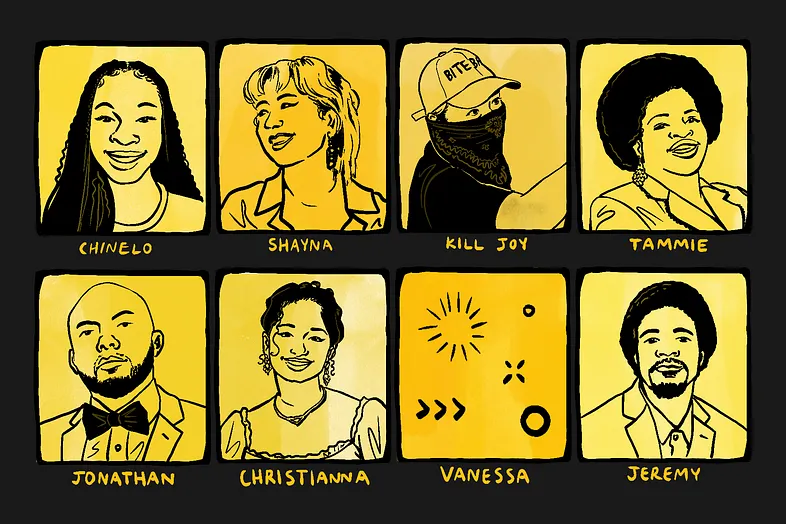
Illustratoins of the No Data About Us Without Us Fellowship created by Hawwa Youngmark
Ms. Tammie and Chinelo’s paths first crossed in 2020 when Chinelo reached out to her for guidance and support concerning her efforts to organize a peer advocacy group to confront discriminatory policies in Fort Bend School District. As a longtime parent advocate, Ms. Tammie had spent decades defending children from punitive school discipline in Fort Bend. Chinelo, then a high school student and co-founder of the Fort Bend ISD Equity Coalition, was busy formulating a set of demands for the district — clear, specific changes that might make their schools places of care rather than control.
Ms. Tammie served as a mentor and sounding board, helping Chinelo think through how to make her demands heard.
Over time, their bond of mentorship evolved into mutual learning, and in their fellowship, they worked together to link Fort Bend’s long legacy of racialized discipline with the wider fight for digital liberation.
A Mother’s V̶i̶g̶i̶l̶ Vigilance
For Tammie Lang Campbell, the fight to defend children in Fort Bend schools has always been personal. Three decades ago — long before today’s “smart classrooms” and AI-powered monitoring — her five-year-old son was body slammed by a police officer at school. Ms. Tammie used every resource at her disposal to fight for justice for her son. But she didn’t stop there.
She never wanted another parent to navigate these experiences alone. So in 1991, she founded the Honey Brown Hope Foundation, a 501(c)(3) nonprofit working from the schoolhouse to the jailhouse to help dismantle the school-to-prison pipeline with direct support, advocacy, and parental resources like its nationally recognized “How to Advocate for Your Child Toolkit.”
From School Pushout to Youth Surveillance
In the NDAUWU fellowship, Tammie Lang Campbell spoke with urgency and clarity about the shifting shape of the school-to-prison pipeline. She emphasized that while the tactics and tools used to criminalize Black youth have evolved, the underlying intent remains unchanged. Where children were once surveilled in hallways and classrooms, they are now monitored through their phones, computers, and social media by powerful AI surveillance technologies.
For Ms. Tammie, this is not innovation — it is escalation. Drawing on decades of advocacy, she has championed an approach that begins with criminal justice reform inside schools and centers families as critical defenders of their children’s rights. Her “parent-in-the-loop” vision of youth digital justice is grounded in the principles of participatory defense, equipping parents and caregivers with the knowledge and tools to navigate and challenge opaque data systems. Participatory defense reframes criminal defense as a collective act of care: rather than facing systems alone, families come together to understand decision-making processes, intervene when necessary, and build new forms of accountability rooted in mutual protection and kinship.
This vision shaped her fellowship project, “The Impact of AI on Students, Education, and Privacy: A Black History Month Event.”
Ms. Tammie intentionally leveraged a commemorative observance that often focuses on the past to turn the community’s attention toward the future, showing how data and algorithms produced by AI surveillance are poised to deepen the harms of the school-to-prison pipeline, if left unchallenged.
For Ms. Tammie, protecting young people goes beyond critiquing harmful technologies. It requires building networks of care strong enough to resist and outlast them.
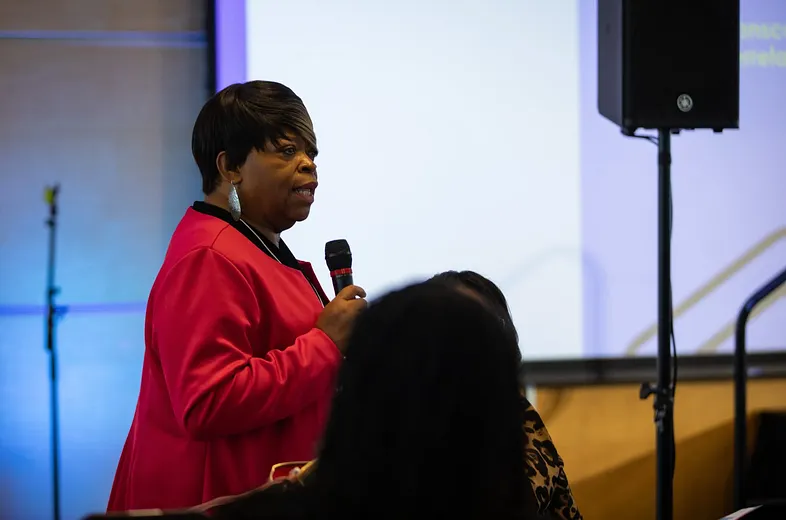
Picture of Tammie Lang speaking at the Data For Public Good Conference
Stories that Refuse to be Silenced
Nearly two decades after Ms. Tammie first found herself defending her son, another young woman in Fort Bend was stepping into the struggle from a different vantage point. In the summer of 2020, as protests against police violence swept the country, high school senior Chinelo Dike began gathering stories from her peers online. Together with her co-founder, Sameeha Rizvi, she launched the FBISD Equity Coalition, a student-led movement to confront racial inequities and punitive discipline in the district.
The response was overwhelming: hundreds of testimonies poured in. Black and Latinx students described being disciplined for “rowdiness,” while others were harassed by school police or silenced when raising concerns.
A federal civil rights probe confirmed what students already knew:
Fort Bend schools disproportionately punished Black children. As Chinelo recalled, many said the police felt more like wardens than protectors.
The Coalition transformed these accounts into action, drafting a set of demands for the district: to reduce school policing, invest in counseling, and integrate into the curriculum the history of racial violence. For Chinelo, this work demonstrated the power of storytelling as both evidence and solidarity, a way for students to see themselves in one another’s experiences and begin to imagine change.
Yet she also recognized the double edge of these digital tools. Social media was where students found community, but also where their words could be censored, flagged, or repurposed as evidence against them. That awareness deepened in 2024, when Chinelo worked with Edgelands and NOTICE on a report documenting surveillance in Houston schools, where web filters and monitoring software echoed the inequities she had already witnessed as an organizer.
She continued this work over the year she was part of the NDAUWU fellowship, alongside fellow cohort member Christianna Thomas, a current high school student. Together, they traced how bundled web filters and surveillance software cut students off from vital resources. LGBTQ+ youth risked being outed if they searched for supportive communities. Others lost access to mental health services or even basic educational materials. In this way, the same systems that promised “safety” ended up extending the reach of punishment into the digital classroom.
Rather than dismiss web filters as a nuisance, Chinelo and Christianna reframed them as political tools — extensions of the culture wars that seek to censor honest conversations about race, gender, and sexuality in schools.
Through workshops with youth organizers, she and her peers began to politicize what students already knew: that web filters shape what they can learn, say, and imagine.
Her vision is not to deny that risks exist online, but to insist that young people deserve self-determined, community-centered approaches to safety — approaches that cultivate collective care rather than criminalization.
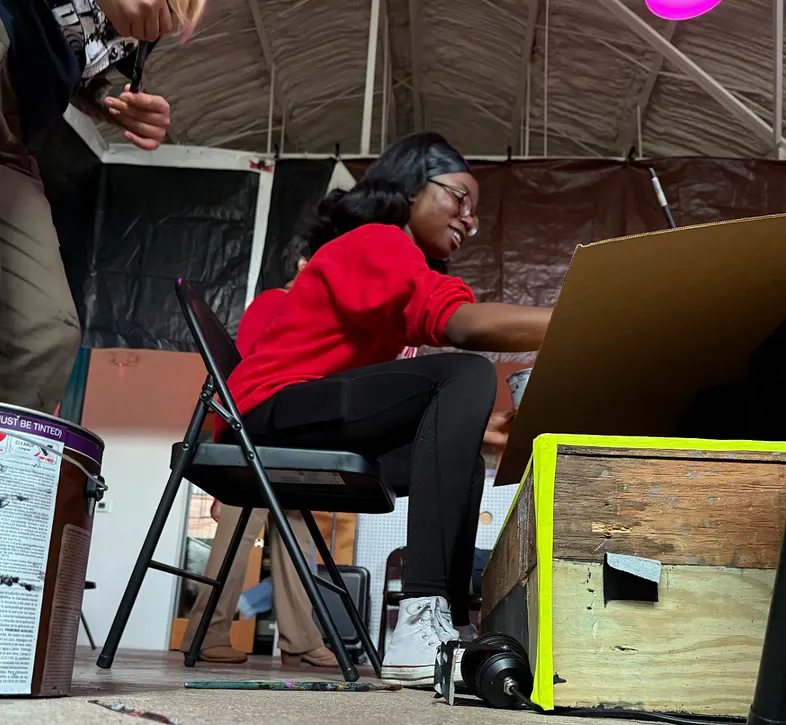
Picture of Chinelo Dike working with the NDAUWU Fellows on the Digtal Liberation Puppet show set
Footstepping Across Generations
The connection between Ms. Tammie and Chinelo began when Chinelo and her peers were still finding their footing as activists, and Ms. Tammie offered hard-won wisdom from years of standing alongside families in Fort Bend. She taught them how to build protective infrastructures — preparing for pushback, documenting abuses, and keeping trusted elders in the loop.
By the NDAUWU fellowship, the relationship had become reciprocal. Chinelo suggested bringing Ms. Tammie into the cohort, where they learned as peers: Chinelo connected discipline to digital surveillance, while Ms. Tammie grounded those insights in decades of organizing.
Together, they modeled what it looks like to resist not only through critique but through kinship — an intergenerational practice of care that counters the inheritance of oppression with an inheritance of solidarity.
Their relationship is a kind of footstepping — carrying forward the unfinished struggles of those who came before while adapting them to confront the new forms that surveillance and punishment take today. In this way, solidarity across generations becomes not only an inheritance but a living practice that binds memory to action. Where “plantation futures” point to the persistence of racialized control across time, their bond demonstrates another kind of continuity: traditions of defense, creativity, and care that can be passed down, adapted, and strengthened with each generation.
The Ground Beneath Their Feet
Ms. Tammie’s and Chinelo’s advocacy unfolded against a landscape where the past is never truly past. Two years before they met, in 2018, construction crews broke ground on the James Reese Technical Center — a futuristic hub for training Fort Bend students in careers like cybersecurity and law enforcement. On this site, workers uncovered a mass grave of ninety-five Black boys and men, prisoners leased out as forced laborers under the convict leasing system that replaced slavery after the Civil War.
Known today as the Sugar Land 95, their lives testify to how Black men and boys were criminalized for the smallest infractions under the Black Codes — charges like “rude speech” or “loitering” that turned everyday existence into a punishable offense.
More than a century later, Fort Bend schools still face federal investigations for disproportionately disciplining Black children, often for equally subjective behaviors — being “too rowdy” or “disruptive.”
The Reese Center stands as both monument and mirror: a site promising twenty-first-century “innovation” while resting atop a burial ground of racialized captivity. This is not coincidence but continuity — a “plantation future” where the logics of surveillance persist, mutating but never disappearing.
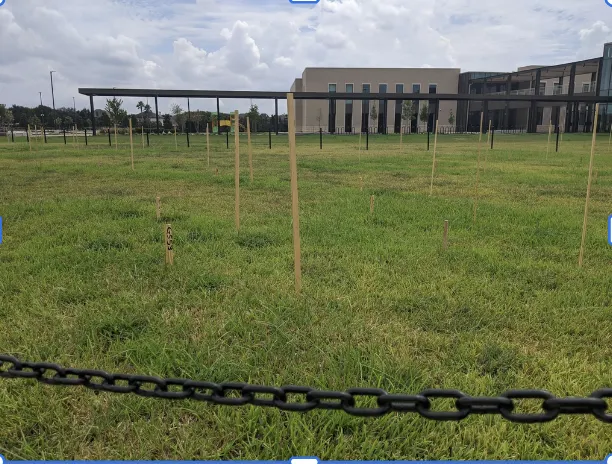
Picture of Fort Bend
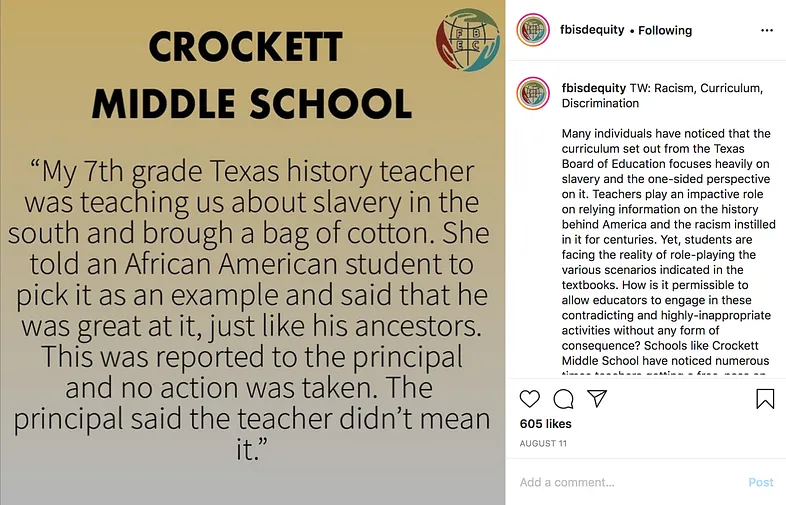
Testimonial from @fbisdequity
Seeds of Otherwise Futures
The stories of Ms. Tammie and Chinelo remind us that Fort Bend’s history is not just buried in the ground — it is alive in the present. The same county where the Sugar Land 95 were forced into labor under the Black Codes is today a site where Black students are disproportionately punished for being “too disruptive” or “too rowdy.”
The logics of surveillance and control endure, even as they migrate into digital systems of monitoring and filtering.
Alongside these harms are continuities of care. By linking parent defense with youth organizing, Ms. Tammie and Chinelo embody an inheritance that refuses to let punishment be the only story passed down.
This is the work of building infrastructures for digital liberation: not only resisting surveillance, but cultivating communities strong enough to flourish in spite of it. In Fort Bend, the ground still carries the memory of captivity. But it also carries the seeds of new futures — futures sustained by kinship, collective care, and the conviction that young people deserve freedom not later, but now.
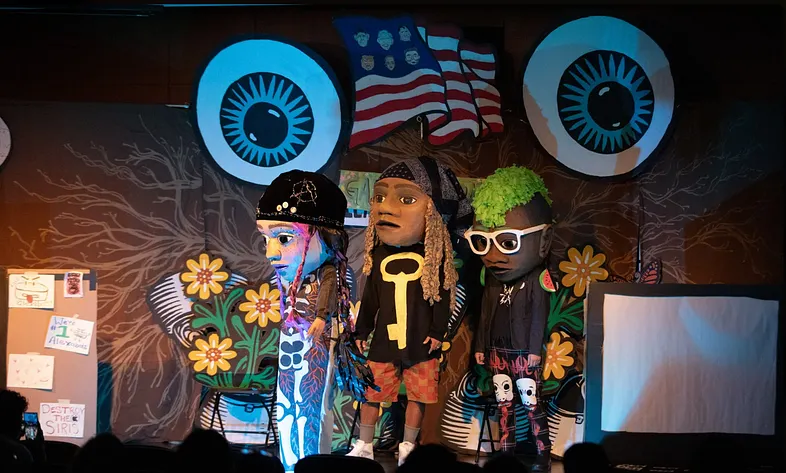
Picture of the NDAUWU Fellows Puppet show, an accumulative project highlighting school surveillance harms within schools
About the Series
This essay is part of the No Data About Us Without Us storytelling series, which shares the lessons and visions that emerged from our fellowship cohort. By highlighting the intertwined journeys of Ms. Tammie and Chinelo, we hope to show how struggles against surveillance are also opportunities to practice solidarity across generations. Their work reminds us that digital liberation will not come from new technologies alone, but from the communities of care we build to sustain one another. In the months ahead, we will continue sharing stories from across the fellowship, each one a glimpse into the infrastructures of freedom being nurtured in classrooms, neighborhoods, and movements across the country.
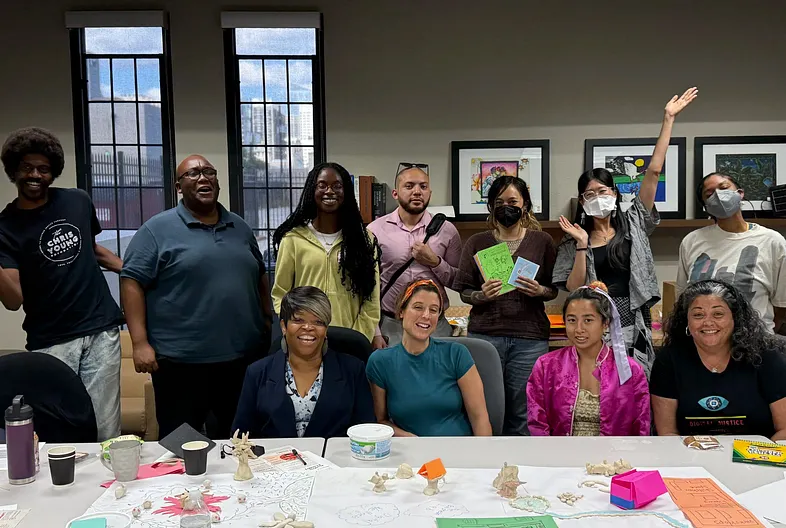
Picture of the NDAUWU fellows and mentors
This essay draws on the No Data About Us Without Us Fellowship, a program of the NOTICE Coalition: No Tech Criminalization in Education and the Edgelands Institute. The fellowship convened grassroots organizers, educators, youth activists, and community leaders to examine how digital surveillance technologies are reshaping school discipline and to explore transformative alternatives that reduce harm and protect the rights and freedoms of youth and young adults.
We are TCIA. We believe people must hold power over technology platforms, not the other way around.
LinkedIn
Website
Bluesky
Substack
Join Mighty Networks and stay connected with the TCIA Community