
Networks and The Future
Title: Networks and The Future
Author(s): Sara Arango Franco
Year: 2026
City: Global
Language(s): English
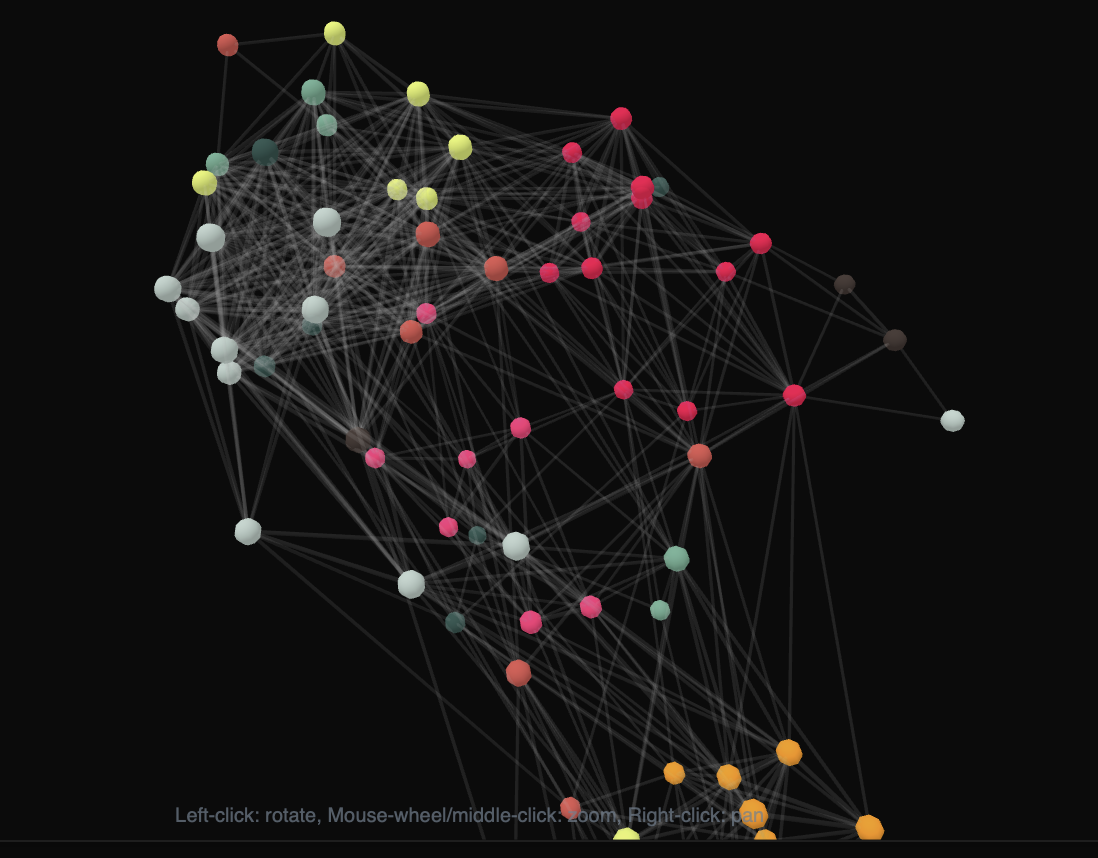
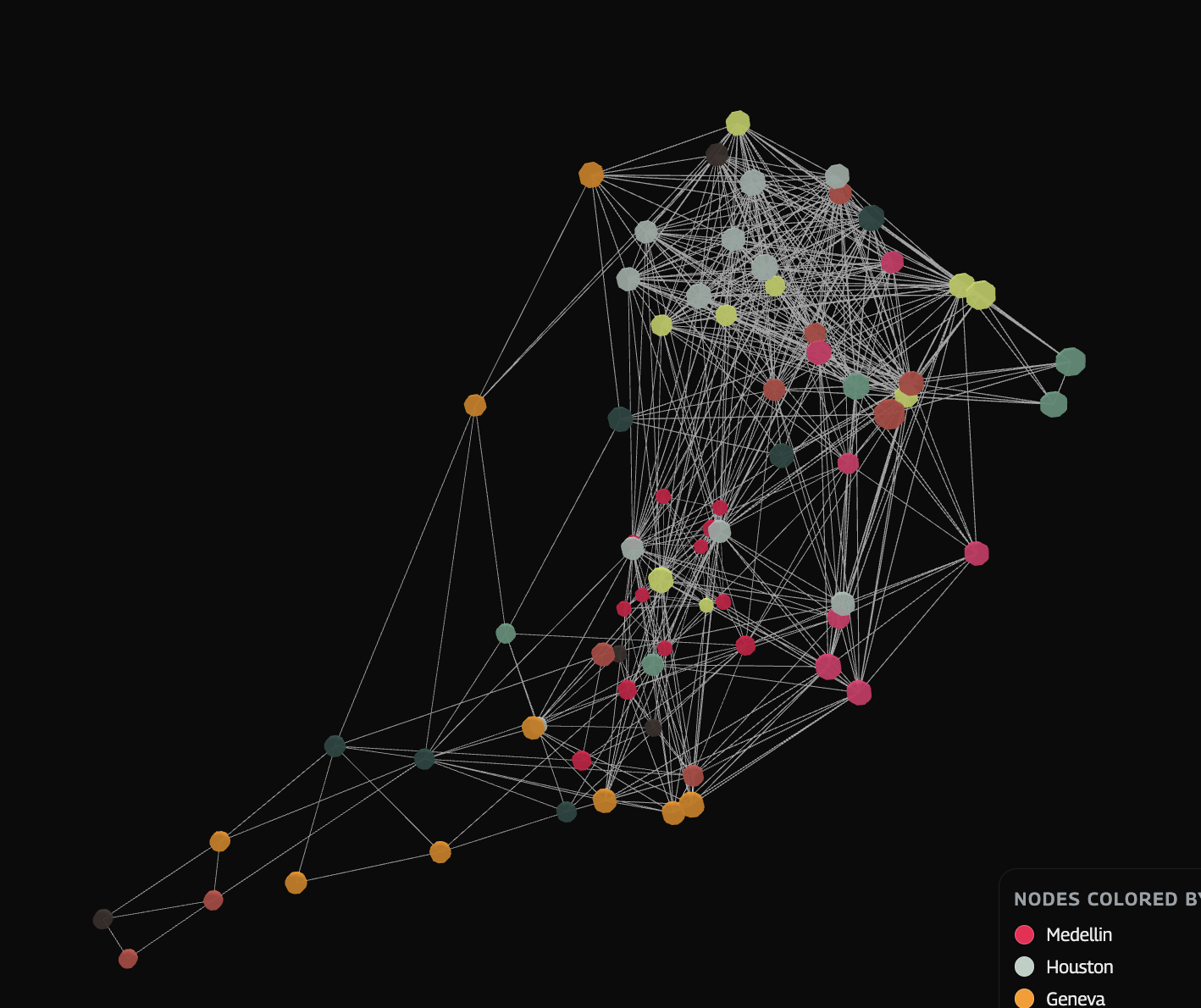
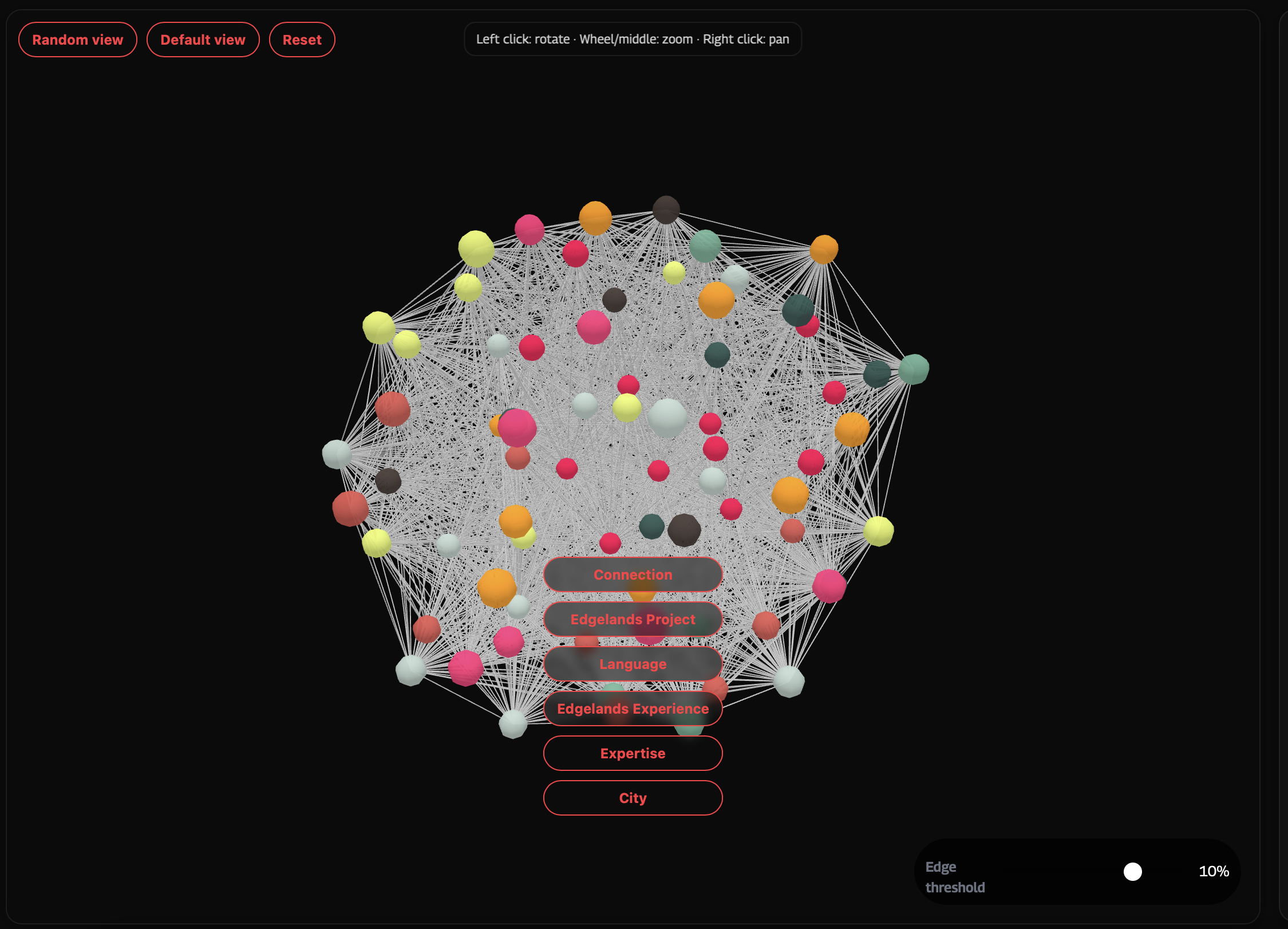
Networks are (representations of) configurations for information to travel, mutate and evolve; possibly transforming the networks themselves along with the journey of such information.
It is perhaps worthwhile noting that the most parsimonious way –that is, the simplest, most agreed-upon way that is still informative enough to convey what it needs to convey– to represent Complexity, in the discrete world, is through networks. Edgelands has, among other things, been a network’s exercise in delving into topics that are extensively complex: deeply inter-related, dynamic, nested.
Our brains, the way humans and goods are transported throughout the world. Networks allow us to see emergence, and scale.
Network representations make a visible case that identity, categorization and representation are fixed objects with limited use, depending on scale.
Of course, choosing the language,symbols and categories to represent and visualize the network brought us back to the perennial issue of categorization: we introduced arbitrary demarcations of reality, that by definition separate us, and then decide the measures by which each of us would be closer to others.
Here are some images to contemplate as we approach the death of Edgelands as we know it.
Networks, like words, carry identitarian and representational qualities embedded in them, fixing things, naming them, separating them. In death, we might imagine these qualities released. Identity and death may be completely orthogonal concepts.
After an organism dies, a plethora of multiple interactions arise, and the substrate –itself composed of other networks– is fed by what is left. It is hard to impose a benchmark to measure the right scale, transcendence and identity of the features that will activate information in their equivalent, human-cultural substrate. Networks change to the point of becoming other networks. Concepts change. But the information is there, being exchanged at high rates, perhaps until an equilibrium is reached. So the activation is real.
And yet we decided to represent this network, as a venture into the future.
Creating this network representation with Dario Rodighiero and Laura García Vargas made us wonder, of course, about common grounds, which have been a recurring Edgelands topic, and the questions posited by our colleagues resonate: How to use the network to go beyond the network?
We don’t know yet how to bring this network to life and keep it going as the institute pops down and beyond, but images are powerful –they are drivers of the human will–, and seeing ourselves as part of it, in it, can help us visualize how this network can extend and ripple into other networks. This is, in itself, a generative exercise, an inviting peek into future networks.
Join us and register now for the Edgelands Network: https://edgelands.notion.site/16b561555d5582d4ba5e8196e31ec7b6